Acne Ai Across Skin Tones Inclusive Design That Holds
Read about Acne Ai Across Skin Tones Inclusive Design That Holds on Cosmi Skin
Acne is one of the most common skin conditions in the world, but the accuracy of the AI tools that detect it has not been evenly distributed. A growing body of peer-reviewed research shows that dermatology AI models, including those built for acne analysis, tend to perform best on lighter skin tones and worst on darker ones. That gap is not a fringe finding. It is a documented pattern in the literature, and it is the reason inclusive design has become a first-class concern in how we build Cosmi's acne pipeline.
This article walks through what the bias problem actually looks like, how Cosmi's analysis is designed to handle it, and where honest limits still remain.
TL;DR: Acne Analysis Across Skin Tones
Key Takeaway: Inclusive acne analysis is a deliberate design choice, not a marketing checkbox. Cosmi's pipeline combines tone-aware image preprocessing, training data curated across Fitzpatrick types I through VI, and lesion detection that looks beyond surface redness to maintain consistent accuracy on every user.
| What Most Acne AI Gets Wrong | What Cosmi Does Differently |
|---|---|
| Trained predominantly on Fitzpatrick I–III images, so darker tones are underrepresented | Curates training data with deliberate balance across all six Fitzpatrick types |
| Detects inflammation by looking for red color contrast, which weakens on melanin-rich skin | Uses morphological and textural features alongside color cues so lesions stay visible without depending on redness |
| Applies the same preprocessing to every image regardless of lighting or tone | Normalizes images in perceptually uniform color spaces (LAB) so lighting and tone are standardized before analysis |
| Reports a single global accuracy figure | Tracks performance per tone band and treats gaps as bugs to fix, not noise to ignore |
Why Inclusive Acne Analysis Is a Real Problem, Not a Theoretical One
The clearest case for skin-tone adaptation in acne AI comes from outside Cosmi. In a 2022 review of dermatology AI studies, Daneshjou and colleagues found that of 21 published dermatology AI studies, only 7 reported patient skin tone at all. Among those that did, Fitzpatrick Types V and VI (the two darkest bands on the standard scale) made up under 10 percent of the training images on average. A model that has seen almost no examples of dark skin during development cannot be expected to perform consistently on it in production.
The problem is not only about training data quantity. It is also about the visual cues those models learn to rely on. The classic sign of an inflamed acne lesion is erythema, the redness that comes from increased blood flow in superficial capillaries. On lighter skin, that redness is usually visible. On darker skin, it often is not. A 2025 review in Cureus found that erythema in Fitzpatrick types IV to VI can appear violaceous, gray, or brown rather than red, and may be partially or fully masked by melanin. Models that detect acne by looking for red color contrast will systematically miss or under-count those lesions.
The downstream effect shows up in the scores. Benčević et al. measured acne segmentation accuracy using the Dice Similarity Coefficient and found a significant negative correlation between accuracy and the proportion of Fitzpatrick V–VI pixels in test images. In other words, the darker the skin in the test photo, the worse the segmentation. This is the practical reality behind the headlines: a model that scores 90 percent on a benchmark skewed toward light skin can drop well below that on a real-world user base that includes darker tones.
For a consumer tool like Cosmi, where the user base spans every skin tone, that gap is not a tolerable margin of error. It is the difference between a useful acne reading and an unhelpful one.
How Cosmi's Acne Analysis Pipeline Adapts to Skin Tone
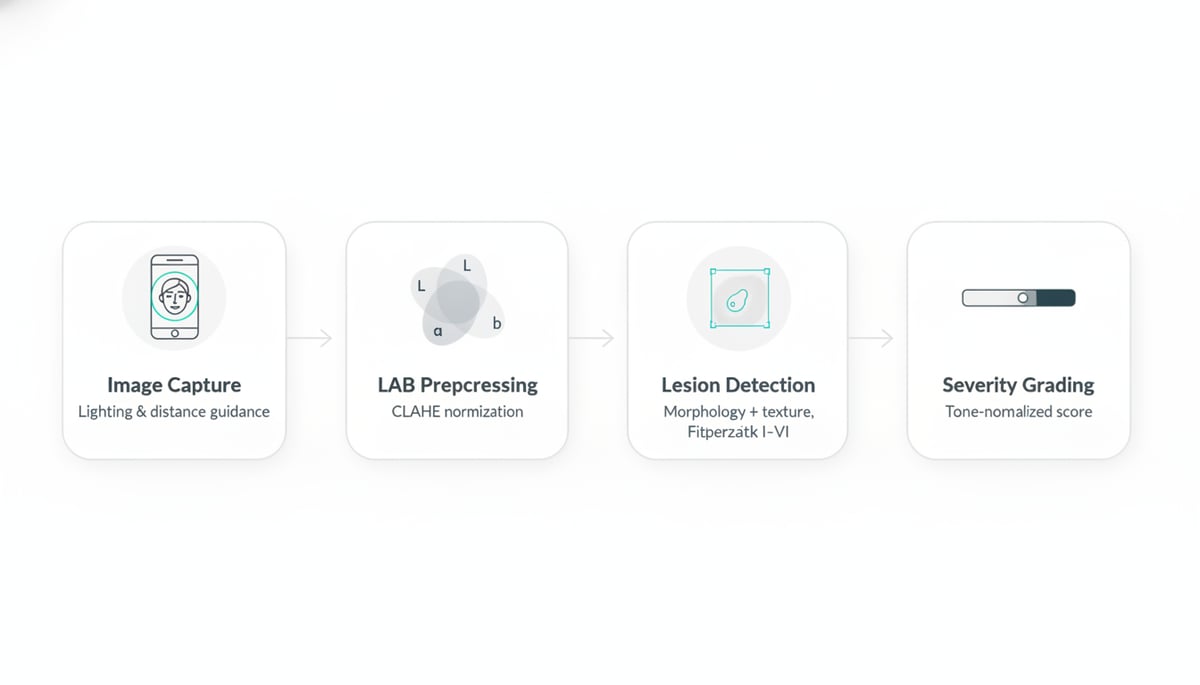
Inclusive acne detection is not a single technique. It is a stack of decisions made at every stage of the pipeline, from how a selfie is captured to how a final acne count is reported. Here is what that stack looks like inside Cosmi.
Training Data Across Fitzpatrick Types I–VI
The foundation of any acne detector is the image set it learns from. Cosmi's analysis model is trained on a curated image corpus that includes representative samples across all six Fitzpatrick phototypes, not just the lighter end of the scale. The Fitzpatrick scale is a six-band classification developed for dermatology that groups skin by its photobiological response (how it burns and tans), and it has become the standard reference for measuring dataset diversity in dermatology AI research (DermaDex, 2024).
Curating a balanced dataset requires more than collecting more images. It requires labeling each image with a tone category and checking that every band meets a minimum representation threshold before training begins. For images that lack a clinical annotation, automated colorimetric methods such as the Individual Typology Angle (ITA), which derives a skin tone category from CIE Lab* color values, are used as a validated proxy. A 2025 validation study by Ulrich and colleagues showed ITA achieves good agreement with clinician Fitzpatrick assignments for types I through IV, making it practical to label large image sets consistently.
Note: Cosmi's acne pipeline uses the six-type Fitzpatrick breakdown rather than a coarser three-band grouping. Recent work by Goyal et al. shows that reducing FST granularity (collapsing 1/2 and 3/4 into single categories) can actually hurt model performance, especially for darker skin. Keeping the six categories preserves the imaging differences that matter.
Image Preprocessing That Normalizes Lighting and Tone
Even with balanced training data, raw user selfies vary wildly in lighting, white balance, and exposure. A photo taken in warm indoor light will make the same skin look different from one taken near a window. Before the acne model ever sees a pixel, Cosmi runs preprocessing designed to neutralize that variation.
One of the techniques used in the broader dermatology AI literature, and which informs our pipeline, is conversion to the CIE LAB color space. LAB is designed to be perceptually uniform: equal numerical distances in the space correspond to similar perceived color differences to the human eye. This makes it well suited to standardizing skin appearance across lighting conditions. A 2024 imaging study used LAB space preprocessing combined with CLAHE (Contrast Limited Adaptive Histogram Equalization) to normalize brightness variability in skin tone classification pipelines, and the approach has been adopted across multiple dermatology AI workflows.
The effect for users is that the analysis is comparing your skin against a consistent reference frame, not against whatever mood your bathroom lighting happens to be in on a given day.
Detecting Lesions Beyond Redness
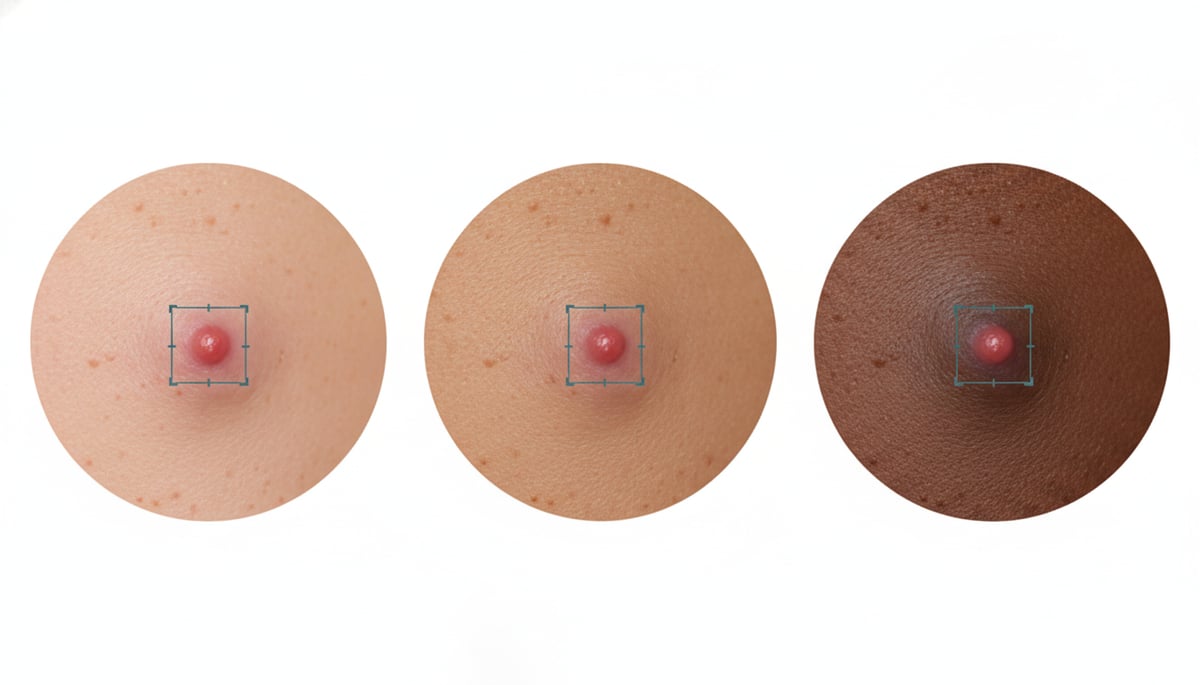
This is where tone adaptation matters most. A naive acne detector treats "red blob on skin" as a lesion. That assumption collapses on darker tones, where inflammation often shows up as a subtle darkening, a texture change, or a slight swelling rather than a visible color shift.
Cosmi's detection model is built to rely on a combination of features rather than color alone:
- Morphology, the shape, border, and elevation of a lesion, which is largely tone-independent
- Texture and surface relief, which capture the way acne changes the smoothness of the skin
- Contextual contrast, the difference between a lesion and the surrounding skin in luminance rather than in red channel intensity
- Color shift cues, used with caution and weighted by how reliably they appear across tones
This approach mirrors what the AcneDet study demonstrated: separating lesion detection from color-based severity grading, and using bounding-box annotation of lesion morphology rather than relying purely on redness. AcneDet's multi-feature design achieved an F1 score of 84 percent on inflammatory lesions across a dataset that explicitly included Asian, European, African, and Latino participants.
Value: Detecting lesions by morphology and texture means a user with deep skin tone gets a count and severity reading that is anchored to the actual physical lesion, not to whether the lesion happened to turn red enough for the camera to see.
Severity Grading That Resists Tone Bias
Acne severity is typically reported using scales like the Investigator's Global Assessment (IGA), a five-step scale running from clear to severe. The IGA, like most clinical grading systems, was developed on populations where erythema is the dominant visual cue. As the Cureus review notes, applying the IGA consistently across skin tones is genuinely difficult.
Cosmi addresses this by separating two tasks that most consumer acne apps conflate: counting lesions and grading severity. The lesion count comes from the morphology-based detector described above. The severity grade is then derived from a combination of lesion count, lesion type distribution (comedonal versus inflammatory versus nodular), and tone-normalized intensity scoring rather than from raw redness intensity alone.
We do not claim that our severity readings match a board-certified dermatologist's IGA grading for every user. We do claim that the inputs to the grade are calculated in a way that does not penalize a user for having less visible erythema.
What This Means in Practice for Users
The practical difference between an inclusive and a tone-blind acne detector shows up in three places users actually notice.
Consistent Lesion Counts Across Tones
A user with Fitzpatrick V skin who takes a weekly Cosmi analysis should see lesion counts that track the actual state of their skin, not a number that drifts downward because the model can no longer see the inflammation. The morphology-first approach makes this possible.
Tracking That Resists Demographic Drift
Cosmi's progress tracking compares your current analysis against your previous ones. If the underlying detector is biased toward a specific tone, that bias will compound over time and turn into a misleading trend line. By using a pipeline that holds up across tones, the trend you see reflects what is actually happening on your skin, week to week.
Routine Recommendations That Match the Reading
The acne reading feeds directly into the personalized routine Cosmi generates, which segments steps into morning, afternoon, and evening slots. If the acne reading is under-counted because of tone bias, the routine will under-treat. If the reading is honest, the routine can match the actual severity. The pipeline decisions described above exist to keep that chain intact from image to recommendation.
Where Cosmi's Inclusive Design Still Has Limits
Honest coverage of this topic requires acknowledging what the current pipeline does not yet do well.
Severe inflammatory acne on the darkest tones remains the hardest case. Even morphology-based detection can struggle when active cysts are large and overlapping, when post-inflammatory hyperpigmentation (PIH) is widespread, or when scarring texture dominates the image. The AcneDet benchmark reported F1 scores of 61 percent for non-inflammatory lesions and 72 percent for post-inflammatory hyperpigmentation, both lower than the 84 percent figure for inflammatory lesions. Those gaps narrow as datasets grow and models improve, but they have not closed yet.
PIH as a separate signal is something we are actively working to improve. PIH is itself a tone-dependent phenomenon: it is far more visible on darker skin and is often the primary concern for users with Fitzpatrick IV through VI even after active acne has subsided. Treating PIH as a distinct tracked condition alongside active acne is a deliberate design choice, and it is informed by the same literature on diagnostic disparities in skin of color.
Lighting conditions outside the capture guide still introduce error. If a selfie is captured in extreme low light, harsh backlight, or with heavy color cast from artificial sources, preprocessing can only partially compensate. The app's on-screen capture guidance is built to reduce this, but no preprocessing chain is perfect.
Self-reported tone labels are not used for analysis itself. Cosmi does not require users to self-identify a Fitzpatrick type before analysis. Tone handling is image-derived, not user-declared. This avoids the well-documented problem of mixed-heritage users falling awkwardly between clinical categories, but it also means the model has to estimate tone from the image itself, which is a non-trivial step.
Note: No consumer AI tool, including Cosmi, replaces clinical diagnosis. For severe, painful, or rapidly changing acne, a board-certified dermatologist remains the right next step. Cosmi's value is in giving you a consistent, trackable reading over time, not in substituting for medical evaluation.
What We Are Working on Next
The literature on inclusive dermatology AI is moving quickly, and so is our pipeline. Three areas are priorities:
- Expanding labeled coverage of Fitzpatrick V and VI in active acne training data, beyond what is currently publicly available, through clinical partnerships and curated annotation
- Modeling PIH as a distinct signal with its own severity grade, so users whose primary concern is post-acne marks get a tracking signal that reflects their actual skin state
- Continuous tone-stratified performance monitoring, so that any regression on a specific tone band is caught and addressed before it affects users
These are not finished features. They are documented priorities. Cosmi's commitment to inclusive acne analysis is a long-term engineering commitment, not a one-time audit.
The One Thing to Remember
If you take one thing from this article, let it be this: the question is not whether an AI acne analysis tool works on lighter skin. The question is whether it works on yours. A tool that cannot honestly answer that question across the full range of human skin tones is not a personalized tool. It is a tool with a narrow audience dressed up as a universal one.
Cosmi's pipeline is designed so that the answer to that question does not depend on your skin tone. It depends on the state of your skin.
Want to see how your own analysis holds up across your routine? Take a free skin analysis on Cosmi and review the acne reading alongside the morning, afternoon, and evening routine it generates. The reading you get is the reading the model sees, not the reading a tone-biased detector would have filtered out.
Tags
Related Articles

From Acne to Radiance: Proven AI Solutions for Clear Skin

AI in Skincare: Unlock Your Best Complexion with Cosmi